
Tahrir and the Islamist-secularist-SCAF triangle
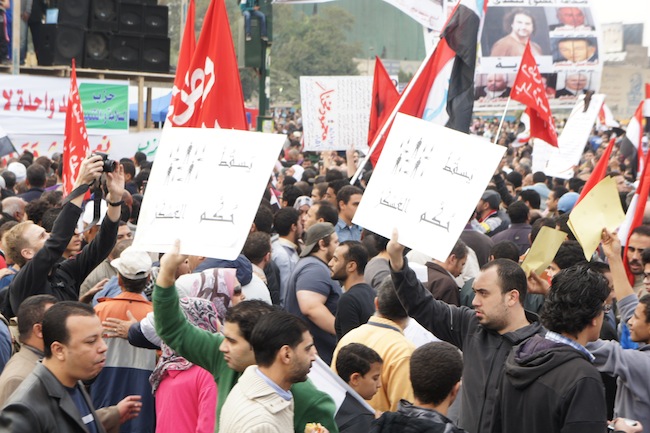 Up front, signs calling for the fall of military government, in the back, a large poster calling for freedom for Alaa Abdel Fattah
I have a rather nasty flu at the moment, but I braved the elements and headed to Tahrir this afternoon not quite sure what to expect. It remains unclear where the dispute over the super-constitutional principles — the main cause of the protest — is at right now.
For a week, after the SCAF (via Deputy Prime Minister Ali al-Selmi) tried to impose exceptional measures for the military, rules for the formation of the constituent assembly and make the principles legally binding, there seemed to clear opposition from the Muslim Brothers, Salafists (who had never even participated in talks) and part of the liberal/progressive parties and revolutionary movements. Talks were ongoing until late last night to secure some kind of compromise — either on the content, or on the principles being binding, or both — but to no avail.
To be honest, I largely agree with the Islamist position on the constitutional principles: they are unnecessary and pretty ridiculous, since the whole point of the coming elections is to elect a parliament that will, via the constituent assembly, write Egypt's next constitution. You can call anything you want binding but the legitimacy of an elected parliament trumps any agreement made behind closed doors. The whole debate has been a divisive waste of time, and it would have been much better for liberals who wanted to get some guarantee that basic rights would be preserved in the next constitution to deal with the Islamists directly rather than through SCAF. This had been Mohamed ElBaradei's initial plan in the summer. Even now, the Muslim Brothers say they will gladly accept a document such as the Azhar Principles announced by Ahmed al-Tayyeb during the summer.
Furthermore, after the stunt the army tried to pull, the parties that have stuck with the principles, such as the Egyptian Liberals and al-Wafd, will probably come out of this pretty discredited — call it what you will, but despite whatever good intentions they may have had it is looking like they were ready to compromise with the military against the Islamists. This Islamist-secularist-military triangle dynamic has been bad for the transition, and bad for Egypt. The silver lining on this cloud, however, is that the military made a major — epic — mistake in trying to impose undemocratic conditions regarding its future role. The funny thing it really didn't have to: there had been a tacit understanding that the military would remain important behind the scenes, and I doubt that the next president, whoever he is, was planning to start challenging the army on its budget. Now, the military has made this an issue when it never had to be one. Their loss.
On the Islamist side, it's important to make a distinction between the Salafists and the Brothers. Tahrir today was heavily dominated by Islamists — although April 6 and other anti-SCAF parties and movements were also present. They came in all shades, from a tiny group of Takfir wa Hijra types with Bin Laden posters to the a pluraity of Salafists from the Nour and Adala parties (and the like-minded) who may want Sharia Law but don't root for al-Qaeda. And then there were the Brothers, also in significant numbers. The key thing is that all echoed the same point: the protest was about having a civilian state and against the military. It's quite something to have a Brotherhood-endorsed protest were there are all sorts of chants against SCAF, the military, the Field Marshall etc. when a few months ago people were still lamenting a SCAF-Brotherhood alliance.
Moreover, even if some liberal activists were despondent about today's protests — a friend called it "Kandahar 2" — I felt the overal mood was quite positive, the crowd, while leaning Islamist, pretty varied and the message largely based on a democratic message and against the staggering misrule of SCAF in the last few months. My favorite sign was a geeky one that had the following closing HTLM tag:
</scaf>
The main thing being articulated was an end to the SCAF's rule. A major demand, frequently uttered in speeches, in conversations with protestors, and on signs was a full civilian government by April, and the election of a president around that time too. Today is not a just a rejecting of the al-Selmi principles, but also a massive rejection of the transition plan presented by SCAF, which would push back the presidential elections until 2013. It is becoming increasingly clear that unless the military intends to stage a coup, this cannot happen. I don't think the super-constitutional principles will survive today, either, although perhaps the MB at least might settle on a much vaguer and non-binding document.
How much should we worry about the organizational strength of Salafists? Their beliefs are indeed deeply worrying, and their numbers are nothing to be scoffed at. They may do well in the coming elections. They reject, unlike the Brothers, any consensus on the next constitution because they want to impose a full Islamic system (which will magically solve all problems!) But one must also concede that they have adopted the right principle in this case of opposing military diktats. Together with the MB, they could very well derive an electoral boost out of that. Liberals who also oppose the constitutional principles should make sure that they are vocal about it too: these elections have, in some respects, become about getting the SCAF out of power.