Egypt's new finance minister and the rentier state
Egypt's new finance minister is the respected economist Hazem al-Biblawy. I am not sure why he was appointed (or why his equally respected predecessor, Samir Radwan, left) but it's interesting to note that one of his academic specializations is the rentier state. He even edited a book about the rentier state in the Arab world in the 1980s, with Giacomo Luciani. An excerpt:
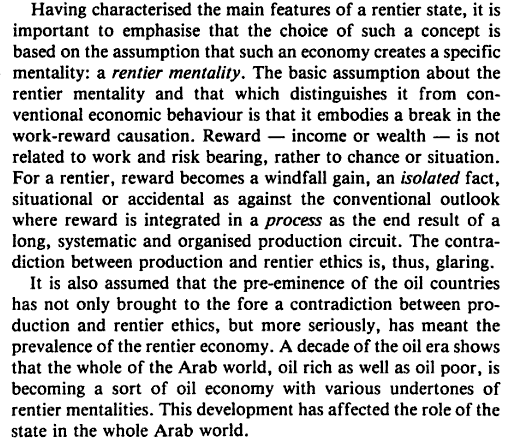
Good theoretical grounding to have as Egypt tries to finance its fiscal deficit by leveraging its strategic rent-value in the Gulf and the West — a policy I like to call Mubarakonomics.


Issandr El Amrani
Reader Comments (6)
Regarding the rentier state in the Arab world, I remember attending a conference organized by Le Monde Diplomatique. Dr Georges Corm (former Finance minister of Lebanon) wrote a very interesting analysis on the matter
http://www.georgescorm.com/personal/download.php?file=al_kabass.pdf
I just read Dr. Corm's article, but I don't understand why he categorizes tourism as creating a rentier economy. Could anyone explain please?
Xoussef: Some might categorize tourism as rent seeking because like mineral resources or strategic rents from outside powers, it involves 'mining' to obtain value and especially foreign currency from outside the citizenry well in excess of the cost of production and normal rates of return. Hence the way tourists can easily be charged different prices than locals, how easy it is to rip off tourists, ability to place all sorts of higher taxes and surtaxes on tourists, etc. It also tends to be more capital than labor intensive, as resorts and tourist facilities cost quite a bit of money, while the labor is generally quite cheap with supply well in excess of demand (including the ability to import even cheaper and more compliant foreign labor). These are of course largely macroeconomic perspectives.
The flipside that you are coming from is of course a perfectly reasonable microeconomic one too, that this is a real business requiring significant investments, and depending on marketing success, government take, regulations, business cost controls, etc. can very easily fail to make money.
Generally, in a developed balanced economy I'd tend to take your side that it's not really rentier state stuff. But in developing economies with states that fail to have normal and fair tax collection but have the power to grab hard currency from outsiders wherever possible, it's probably reasonable to lump it in the rent-seeking strategy bucket.
Re: tourism and rentierism, it's simpler than that IMHO - rentierism only requires that the state can control or monopolize rents from a particular source of foreign currency revenue. Even worker remittances count if the state requires that all foreign currency be exchanged through state institutions or banks. That's the theory at any rate. With tourism I think it counts as rentier because the state gets to control revenues from museums and tourist sites, gets visa revenues and takes a cut from any hotel or whatever that wants a permit to be able to host foreign tourists (i.e sell them liquor!)
But if Egyptians can't look into, and fix, their problems
http://www.jpost.com/MiddleEast/Article.aspx?ID=230235&R=R1
how will they ever improve?
Thank you for your explanations, from that perspective it make sense.