
Egypt, Pakistan, the US and the "right side of history"
Congress is going ahead with plans to make aid to Egypt, including military aid, contingent on Egypt’s relations with Israel and a successful transition:
Reflecting concerns about uncertainty within the Egyptian government, the bill would restrict $1.3 billion in security assistance to Cairo and $250 million in economic assistance until the secretary of state certifies to Congress that Egypt is abiding by a 1979 peace treaty with Israel, military rulers are supporting the transition to civilian government with free and fair elections and “implementing policies to protect freedom of expression, association and religion and due process of law.”
These and other restrictions — notably on the Palestinan Authority and Pakistan — carry “national security wavers” — meaning the Secretary of State can easily lift them. ( Read more: Congress moves to restrict aid to Egypt, Pakistan )
Meanwhile Mamoun Fandy says Egypt could be come worse than Pakistan and underlines Tantawi’s experience in that country during the abominable reign of Zia al-Haq:
The past experience of three major players on the Egyptian political scene ― the ruling Supreme Council of the Armed Forces (SCAF), the US Embassy and Islamists ― suggests that Egypt may soon come to resemble Pakistan.
But why Pakistan and not Turkey? Though many have long hoped to implement the Turkish model in Egypt, Pakistan ― not Turkey ― seems to be the most plausible outcome. In fact, Egypt may turn out a worse version of Pakistan.
Field Marshall Hussein Tantawi, the head of the ruling SCAF, worked as a military attache in Pakistan and has made no secret of his admiration for civil-military relationship there. In Pakistan, he believes, politics is the job of politicians but the military maintains the right to change the power equation whenever it wants, because state affairs are too important to be left completely in the hands of civilians.
Over the last 40 or so years, Pakistan has seen military coups led by generals Zia-ul-Haq and Pervez Musharraf. In the Pakistani power equation, the army is the compass. > US Ambassador to Egypt Anne Patterson is also experienced in Pakistani affairs, following years of work there at a time when political tensions between the two countries ― in the aftermath of the September 11 attacks, the invasion of Afghanistan and the rise of Islamists in Afghanistan and Pakistan ― were at their peak.
Patterson is prepared to implement a similar plan in Egypt ― a currently unstable country that has important military and religious waves that need to be tamed to incorporate US interests into their agendas. Having successfully led a similar process in Pakistan, Patterson is the right woman for an Egypt that is transforming into another Pakistan, with the rise of the Salafi-led Nour and Brotherhood-led Freedom and Justice parties to power.
Fandy gloomily concludes:
We should therefore brace ourselves for the pakistanization of Egypt. Thinkers should get busy studying the Pakistani model instead of wasting their time examining a Turkish model that will never happen.
I don’t know where Fandy gets his info about Patterson’s approach, although it is certainly true that the US ambassador, who is in close contact with SCAF, has also had higher-level and more regular meetings with the Muslim Brothers than publicly acknowledged. The recent visit of John Kerry and his encounter with senior Brothers goes in the same direction.
Of course Egypt is currently too unstable and murky right now to discern any definitive direction. But a US-MB-Army triangle is one of the worst possible outcomes imaginable in my opinion, with built-in sources of recurrent tensions. Much better to have a weakened army and strong MB in the context of a system that, even if unstable, still has civilian rule at its core. The recent positions of the Obama administration emphasizing civilian rule suggest to me that at least part of the Obama administration is not yet committed to implementing a Pakistani policy in Egypt, but I fear CIA, CENTCOM and a good part of the State Dept. may very well be — and they can be more influential than a president, particularly in an election year.
Here’s a recent piece in al-Masri al-Youm that shows Egyptian civil society reactions to this perceived trend:
In the interim, it seems that the US, Egypt’s military and its ascendant Islamist forces are engaging in a precarious dance. The US’s uncertain posture has some Egyptians worried about what will come next in its relationship with the Western power.
“I’ve never seen Americans so confused and worried as I have ever since January,” says Hisham Kassem, a liberal political analyst who is in regular contact with American officials. “I know that security and stability are American interests, not civil rights, in the coming period in Egypt.”
American officials are saying otherwise, though, emphasizing Washington’s commitment to democracy in Egypt regardless of the elections’ outcome.
“Now, in Egypt, new actors will be seated in the parliament, including representatives of Islamist parties,” US Secretary of State Hillary Clinton said on 6 December, a few days after it became clear that the Muslim Brotherhood’s Freedom and Justice Party was poised to dominate the coming parliament.
She also called for fair and inclusive elections, and said the United States expected those elected to uphold universal human rights, including women’s rights and freedom of religion, as well as maintain peaceful relations between Egypt and its neighbors.
On 11 December, US Senator John Kerry, who heads the Senate Foreign Relations Committee, visited Cairo, where he met with Field Marshal Hussein Tantawi, newly appointed Prime Minister Kamal al-Ganzouri and high-level representatives of the Muslim Brotherhood.
“You can tell whom the American government thinks is the most important from the people Kerry met with and in this order: Tantawi, Ganzouri, the Muslim Brotherhood,” says Ziad Abdel Tawab, the deputy director of the Cairo Institute for Human Rights Studies. “No civil society groups, no liberals were included.”
Read more in the story for reactions by a number of analysts and activist.
In a sense, from a realpolitik perspective, one can’t blame the US for dealing with those personalities and institutions that wield power both on the street and in practice. Both the military and the Muslim Brotherhood fit that description, and the elections’ results so far confirm this trend.
Nonetheless, there is an alternative policy: criteria-based relations with Egypt that do not rely on who’s in power but how those in power wield it. It implies a withdrawal from Egypt and the region that is not palatable to the mainstream US foreign policy community and political class (Ron Paul aside). It means ending policies that have made Washington a domestic player in Egyptian politics — a policy that may have had its rewards but also high costs in terms of image, soft power, etc.
The relationships that the US has maintained with client states like Egypt and Pakistan for the past 30-40 years have demonstrably been disastrous, severely hindering natural political processes in these countries, contributing to the marginalization of non-identity based political movements, and creating a wide range of problems for the US and its citizens, notably exposure to terrorism. It is nothing worth reproducing.
All this is worth keeping in mind at a time when SCAF, which has rewritten the history of the Egyptian uprising of late January 2011 to make it about the army siding with protestors against Mubarak rather than shoot them, and the US, which demands credit for not backing Mubarak and pressuring the army not to shoot protestors, respectively deny reality and stay mum.
It is an inconvenient fact that the the latest Egyptian crisis is the culmination of a steady drift by the Egyptian military towards using unjustified, often gratuitous, force against protestors. starting with:
- the forced “virginity tests” of March,
- the first raid on Tahrir Square in April,
- the panicked handling of the Maspero protests in October,
- the events that led to the Mohammed Mahmoud St. protests of November,
- and now the direct, unvarnished and senseless encouragement of soldiers to throw stones and Molotov cocktails at protestors, among so many other crimes.
Obama and Clinton tried to take credit in February for their role in preventing the Egyptian military from killing protestors (I’ve long thought the army was not ready to do so then, since it could simply get rid of Mubarak and was unsure that its own would follow orders — the situation and context nine months later is obviously different).
Well, now the army is killing protestors and all doubts about whether this is intentional or mere incompetence should have vanished — and with it, the narrative that the Egyptian military and US are on the “right side of history”. This could very well be the moment in which the “Egypt is the next Pakistan” theory is tested, with all its manyfold implications.
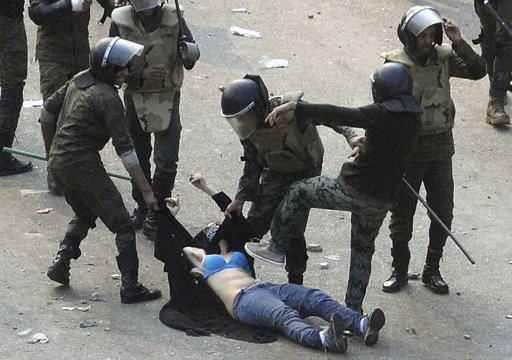 Another one for the virginity tests, perhaps?