
A personal note on Tunisia's elections
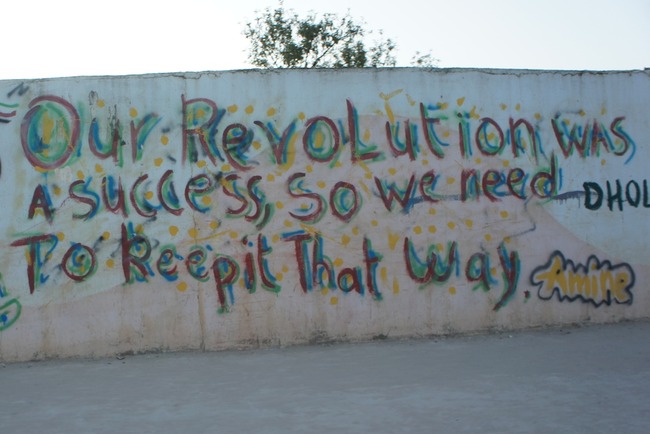 Graffiti in Ariana, a suburb of Tunis
I have a confession to make: I used to hate Tunisia. I spent some time reporting there in the last decade and had an awful experience, including a fistfight with police informants who were following me at one point. Many others have had similar experiences. But most of all I disliked Tunisia because so many Tunisians I met seemed perpetually on the verge of a nervous breakdown, which I thought was because they were partly complicit in their ordeal under Ben Ali.
Of course I met admirable Tunisians: I remember how, at a conference of human rights activists in Casablanca, a Tunisian woman broke down in tears as she told me of the daily humiliations the police subjected her to when she visited her husband in prison. But I thought far too many of her compatriots were silent, and this beautiful country seemed, compared to boisterous Egypt where I lived, dead in the soul. This was no doubt unfair — I was, in part, blaming the victims. I have never had to endure what they were subjected to.
The Tunisia I have visited is another country, and not just because Ben Ali is gone. It feels like a different country. Yes, the Tunisians still have their national character: they are a serious-minded, persnickety, stubborn people (the opposite of Egyptians). But they now have a sense of humor, a levity, that I had rarely encountered before. Gone is their old dourness; they have a joie-de-vivre that I had never seen before. It is extremely moving to see when you knew the old Tunisians.
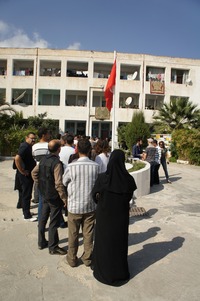 A queue at a polling station in Bizerte, northern TunisiaI now hold Tunisians in almost unreserved admiration: they are a fantastically reasonable, hard-working and couragerous people (please indulge this post’s generalizations about national character.) Their revolution not only seems to have inspired many others in the region, but it is also a reference for the global protest movement we are seeing emerge. No wonder Nahda’s leader, Rachid Ghannouchi, felt he could make a tongue-in-cheek remark at a campaign rally on Friday about Tunisia supporting the uprisings in Egypt, Libya, Syria, and Wall Street.
Driving around northern Tunisia today, I saw tremendous enthusiasm. The long lines at polling stations and the preliminary turnout of at least 70% (although this is probably calculated from the eligible voters who registered, so should be taken with a grain of salt) confirms this. I heard, notably in rural areas, of vote-buying or parties that used gifts to woo voters. This is not surprising. My impression, however, is that these elections were generally the real thing. The aftermath — what the constituent assembly will do (which I’ll discuss tomorrow) — is a much bigger question mark, and more important for Tunisia’s transition to democracy.
I was struck in my small sampling of voters by the act that while Nahda seemed dominant, many voted for other parties with a strong record of opposition to Ben Ali, such as Moncef Marzouki’s CPR, Najib Chebbi’s PDP or Mustafa Ben Jaafar’s al-Takkatul (all left/social democratic and secular). An overall trend is that, with programs often largely similar, people voted for parties, in the words of one young woman, “that are as distant as possible from Ben Ali.” I think that is why Nahda may do particularly well — not just because of an Islamist/conservative vote, but because of a let’s-give-the-dissidents-a-chance vote. (I’ll write more on Nahda and other parties in the coming few days.)
The elections are expected to return a fairly diverse constituent assembly. There are 111 parties, and many independents lists. Some districts of Greater Tunis like Ariana have 95 lists (that’s 95 choices on the ballot!) Many of these won’t make it at the national level. The system used is a largest-remnant proportional system, so with so much competition often only the top candidate in the list will get a seat. This system is partly designed to prevent a single party (read: Nahda) from doing too well, but will also give middle-size parties a better chance. For any sort of accurate predictions, I think we’ll just have to wait for the results tomorrow: as for any dictatorship, there is simply no accurate political map of the country. I suspect there will be surprises, particularly as over 40% of Tunisians were undecided going into the election.
For now, on this beautiful sunny day in which people cried while queing for hours to vote for the first meaninful election in their life, I love Tunisia.
Note: I have written two op-ed pieces about the Tunisian elections: one appeared yesterday in The National, the other is in tomorrow’s Guardian.