
The Economist on Mubarak's Egypt
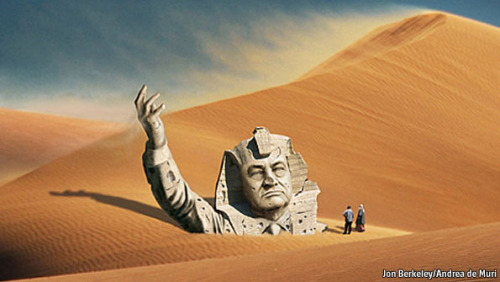
This week's Economist has a special on Egypt well worth checking out. Considering The Economist only does these country surveys about every decade, this might be very well be the third one about Mubarak. I wonder how it compares to previous ones.
The overall tone of the report is a mixture of cautious optimism and a lament of some of the Egypt's failings — its corrupt police state, its education. In light of the woe-is-us mood that dominates in the country and some alarmist accounts of Egypt being on the brink of collapse, it's refreshing to point out the dramatic social and economic changes that the Mubarak era has introduced. Will they turn out to be changes for the better, or not, or were they inevitable changes in a world that influenced Egypt much more than Egypt could influence it?
I have been working on a long survey of Egypt's economy, which gave me an occasion to read some of the laws passed in the last decade and review the economic policies put in place by the Nazif government. There is no doubt these are some of the most dramatic changes introduced in Egypt in decades — not just changes in regulations but a fundamental change in approach. On a personal level, I think some are essential (for instance the extremely unpopular — with the upper middle class — real estate tax) and others are ill-thought (a practically flat income tax? no living minimum wage?), with unnecessarily negative social effects. Their problem is that these changes were implemented with no democratic oversight, no public debate that could have any impact, and in the middle of a succession crisis that further delegitimized these reforms. One major question about Egypt's future is how much permanence these reforms will have — how deeply they will be institutionalized and made palatable to Egyptians as a blueprint for development, which will necessitate some level of democratization, increased representativeness, and a new idea of the social contract to made explicitly.
The Economist has this to say about Egypt's future politics and what models might apply:
The government’s plan to perpetuate itself in office, via the traditional electoral rigmarole, is likely to go ahead. Predictions of change in Egypt have almost always proved wrong; generally it bumbles along much as usual. This time may just be different. The country now faces three main possibilities. It could go the way of Russia and be ruled by a new strongman from within the system. It might, just possibly, go the way of Iran, and see that system swept away in anger. Or it could go the way of Turkey, and evolve into something less brittle and happier for all concerned.
In the short term, the Russian model seems most likely. But to really get somewhere, it's Turkey's path that has to be followed. This ties in nicely to another remark on Egypt's regional decline:
The mess next door has long been a drain on Egypt’s energies. Yet being saddled with nasty neighbours and demanding partners is not the only reason for Egypt’s relative decline. Egyptian skill at the game of geopolitics has atrophied as its professional diplomats have found themselves elbowed aside, replaced by a circle of aides to Mr Mubarak who share his outlook. Perhaps more importantly, Egypt’s leaders have failed to absorb an important lesson: that old foes such as Israel, new rivals for regional influence such as Turkey and even small non-state actors such as Hamas are strengthened by democracy. In Egypt, that still seems some way off.
Do check out the magazine's leader on Arab autocracy (in Egypt and Saudi Arabia, mostly) and the questions raised by the coming successions. Come to think of it, it's not only those two — Algeria, Tunisia, Libya, and Oman also face quite uncertain future leadership...