
Is Egypt's Delta going to drown, or not?
Yesterday was too packed a day to continue the short post I put up.
But I do want to report on one highlight of yesterday's conference at the Biblioteca Alexandrina on the UNDP's latest Arab Human Development Report, on human security, and specifically the challenge of climate change and water management in the Arab word.
For a few years now scientists have warned that rising sea levels in the Mediterranean threaten the sea's coastline, and Egypt's Delta in particular. We've seen dire predictions — 4500 km2 of land flooded, 6-14 million people displaced — as well as the threat of infiltration of seawater into aquifers, making agriculture in areas not affected by the floods more difficult.
What I had not quite realized is that while some have said the predictions are a bit too alarmist, there is actually quite a healthy debate among the specialists about the nature of the threat. Two diametrically opposed views were presented yesterday, delving into issues of sea level rise, currents patterns, erosion patterns, possibilities for mitigation and a lot more stuff that a non-specialist like me can't fully appreciate.
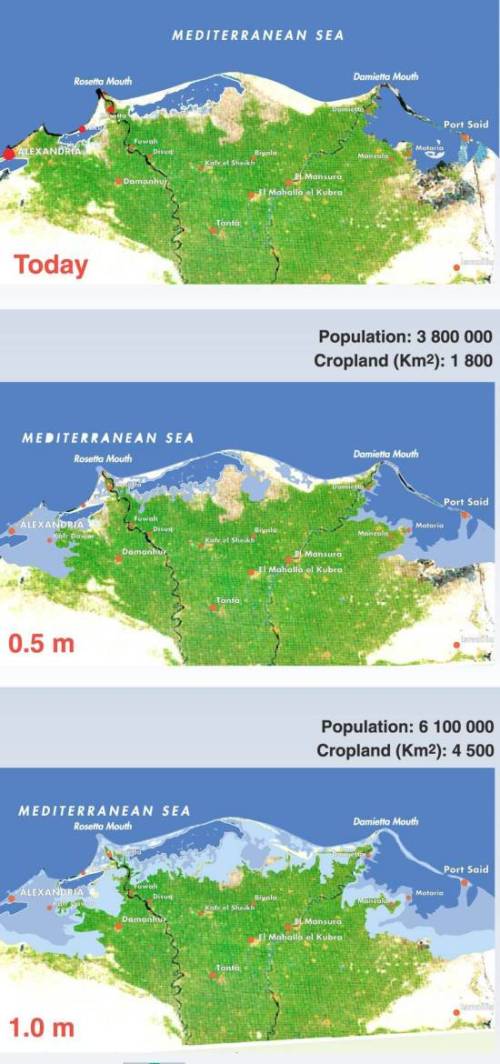
The first view, endorsed by the International Panel on Climate Change (IPCC), says that the threat is very real and good parts of the coastline (mostly around and Alexandria and towards Port Said) are at risk. It also stresses that the impact on aquifers is extremely serious, and that climate change will almost certainly have a devastating impact on Egypt's agricultural heartland, with 15% of the country's arable land affeted. It proposes the construction of a LE20 billion (about $3.5 billion) underground wall by the shore, made of a substance called plastic concrete, that will protect underground freshwater from seawater, as well as as protection for land, and other drastic measures to face the possibility that seawater may rise by up to 1.5m by the end of the century.
The other view says that the data that IPCC endorsed is flawed, and that newer and more complex models exist that suggest that while a rise in sea levels is a real prospect, its impact on Egypt's coastline can be much more easily controlled. It points out that there are a lot of natural defenses, most notably dunes, on the coastline and focuses on preserving them and funding research to understand them better. It argues that one (overground) wall near Port Said built in 1820 by Muhammad Ali still exists and has done its job fine. It says there are a few problem areas, and these need to be addressed, but that the focus of efforts should be understand patterns of erosion, currents, etc. on the coastline and have more systematic monitoring to be able to address the problem.
I can't evaluate the science of either claim. The IPCC regularly reviews new data as it becomes available, and the next review of this question will be in a few years. Perhaps new data will change the prediction, or confirm them. Either way there is a serious problem to deal with, and there is general agreement about risks of groundwater penetration. What the first view has in its favor right now is its endorsement by the IPCC, and that the alternative scenario has yet to be peer-reviewed.
But the conference was a really good example of real debate about climate change, away from the recent controversy over emails by IPCC scientists. It's grounded in a very specific area, and the researchers on both sides are Egyptians who have a real, direct concern for their country's environment.
There is also growing civil society involvement around this, trying to mobilize the government to dedicate appropriate resources to the problem. The problem is also being internationalized institutionally (naturally the problem is international by definition), with a Mediterranean Action Plan backed by the EU about to go in action for coordination between the 21 countries that border the Mediterranean Sea. One way or another, the time to act is now, first with more research, and then with solutions. We may be a few years away from starting a megaproject of dikes and underground walls, but efforts to preserve natural defenses (for instance by stopping construction companies from taking sand from the shore) can be implemented now. And that means tackling issues of corruption and governance — Egypt's perennial, overarching problem.