
Signs...Everywhere then Nowhere in Someplaces
This week there are several small stories, including by AFP, about all the Pro-Mubarak signs coming down around Cairo. The Sand Monkey wrote a post on 15 June where he ridiculed the whole process by saying, "So Mommy Dearest Condi is coming to visit, and we all have to behave ourselves huh?".
Perhaps it is just a coincidence but the signs came down on the 12th/13th of June shortly after FM Ahmad Abul-Ghait announced that US Secretary of State Condi Rice would be visiting Egypt on June 20th. This triggered the speculation that the signs are disappearing so as not to underscore to Rice that Egypt's electoral season is a sham.
For Egyptians, government-supporters decorate the city with signs of the president that clearly transmit messages that "we all know who is firmly in charge" and "who will be elected come September". To their American patron, they take the signs down so as to give the appearance that reform and competition characterize the ongoing electoral process. It makes everything look all the more pathetic and crafty.
If the signs reappear quickly after Rice departs Monday night then it will be a confirmation that the theory was right.
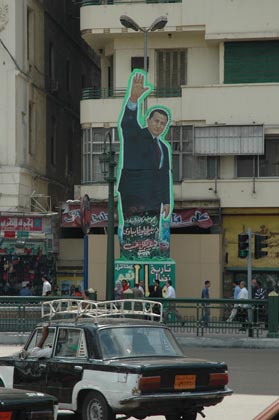
The most imposing of the signs was this wooden monstrosity. There was a copy on the corner of Ramsis St. between the Lawyers and Journalist syndicates. There was also a copy of it in Tahrir square that appeared on the day of the referendum vote. A second Tahrir copy appeared shortly after to emphasize the point. This particular sign was said to be 3 meters tall, but it looked to between 6-to-7 meters tall. In addition to its size, the head of the president would light up with blinking multi-colored bulbs at night.
After being out a bit this week, a trend is detectable.
All the major pro-Mubarak signs are gone from the major thoroughfares and city squares but are still up in places like Imabab's Midan Kit-Kat and Sayida Zaynib. I am guessing Rice will not be passing through through areas if the news reports and speculation is correct.
So, really, what is happening is the signs are (temporarily?) coming down in selective areas.
_________
The Interpretation:
One of the large Mubarak signs in Tahrir was attracting more attention that its identical siblings around town.
It was placed in front of the famous Ali Baba cafe. When one looked at it from the street, you see Mubarak waving in front of the cafe with the words "Ali Baba" in English and Arabic.
Now, it did not take long for some witty Cairene to grab onto the symbolism. You see, according to their version, Mubarak's hand is really a preventative gesture to keep people away from the cave of his forty thieves of ministers and connected cronies.
As the joke circulated, the sign remained.
______
The Story:
I cannot risk ending this post without detailing the story behind the photo above. I was on my way to meet up with friends near Cilantro (AUC). I was a little early so I hopped out of the cab and moved to the square's center to capture the shot. As I stood in the center of Tahrir's roundabout, I snapped a few shots off of the large wooden Mubarak sign.
A traffic officer approached me and told me that it was "forbidden to photograph". I explained that I had never heard such a thing in touristic place like Midan Tahrir. He informed me that this was the way things were and if I wanted to I could speak to his boss. I responded that I very much would like to.
So he escorted me to one of those smallish sun-shading shelters where the highest officer in charge hangs out. He was a fat man who had a mouthful of sunflower seeds that he unintentionally spit all over when he spoke. He asked me what the problem was. I said I had taken a picture and the officer said it was forbidden. He looked perplexed and said, "what did you take a picture of?" I relied, "the sign of the president". He looked over and said, "yeah, he's right. You are not allowed to take a picture of that." I asked, "Why?" He responded, "because that is the way it is."
Sensing that no law breaking going on, I asked, "So there is a law that says this....that one cannot take pictures of the president." He said, "Yes."
I came back at him, "I don't believe you." Then, realizing that he was debating a persistent foreigner over a trivial matter, he looked at me and said, "look, you can take pictures of the president, we just don't like people taking pictures of that one.""Why that one?" I asked. He looked and said plainly, "because that is not a nice picture of him (al-suwar di mish helwa)."
I respectfully disagreed and thanked him for his time. Then I bid the officer a courteous farewell, which he returned smilingly.
Perhaps it is just a coincidence but the signs came down on the 12th/13th of June shortly after FM Ahmad Abul-Ghait announced that US Secretary of State Condi Rice would be visiting Egypt on June 20th. This triggered the speculation that the signs are disappearing so as not to underscore to Rice that Egypt's electoral season is a sham.
For Egyptians, government-supporters decorate the city with signs of the president that clearly transmit messages that "we all know who is firmly in charge" and "who will be elected come September". To their American patron, they take the signs down so as to give the appearance that reform and competition characterize the ongoing electoral process. It makes everything look all the more pathetic and crafty.
If the signs reappear quickly after Rice departs Monday night then it will be a confirmation that the theory was right.
The most imposing of the signs was this wooden monstrosity. There was a copy on the corner of Ramsis St. between the Lawyers and Journalist syndicates. There was also a copy of it in Tahrir square that appeared on the day of the referendum vote. A second Tahrir copy appeared shortly after to emphasize the point. This particular sign was said to be 3 meters tall, but it looked to between 6-to-7 meters tall. In addition to its size, the head of the president would light up with blinking multi-colored bulbs at night.
After being out a bit this week, a trend is detectable.
All the major pro-Mubarak signs are gone from the major thoroughfares and city squares but are still up in places like Imabab's Midan Kit-Kat and Sayida Zaynib. I am guessing Rice will not be passing through through areas if the news reports and speculation is correct.
So, really, what is happening is the signs are (temporarily?) coming down in selective areas.
_________
The Interpretation:
One of the large Mubarak signs in Tahrir was attracting more attention that its identical siblings around town.
It was placed in front of the famous Ali Baba cafe. When one looked at it from the street, you see Mubarak waving in front of the cafe with the words "Ali Baba" in English and Arabic.
Now, it did not take long for some witty Cairene to grab onto the symbolism. You see, according to their version, Mubarak's hand is really a preventative gesture to keep people away from the cave of his forty thieves of ministers and connected cronies.
As the joke circulated, the sign remained.
______
The Story:
I cannot risk ending this post without detailing the story behind the photo above. I was on my way to meet up with friends near Cilantro (AUC). I was a little early so I hopped out of the cab and moved to the square's center to capture the shot. As I stood in the center of Tahrir's roundabout, I snapped a few shots off of the large wooden Mubarak sign.
A traffic officer approached me and told me that it was "forbidden to photograph". I explained that I had never heard such a thing in touristic place like Midan Tahrir. He informed me that this was the way things were and if I wanted to I could speak to his boss. I responded that I very much would like to.
So he escorted me to one of those smallish sun-shading shelters where the highest officer in charge hangs out. He was a fat man who had a mouthful of sunflower seeds that he unintentionally spit all over when he spoke. He asked me what the problem was. I said I had taken a picture and the officer said it was forbidden. He looked perplexed and said, "what did you take a picture of?" I relied, "the sign of the president". He looked over and said, "yeah, he's right. You are not allowed to take a picture of that." I asked, "Why?" He responded, "because that is the way it is."
Sensing that no law breaking going on, I asked, "So there is a law that says this....that one cannot take pictures of the president." He said, "Yes."
I came back at him, "I don't believe you." Then, realizing that he was debating a persistent foreigner over a trivial matter, he looked at me and said, "look, you can take pictures of the president, we just don't like people taking pictures of that one.""Why that one?" I asked. He looked and said plainly, "because that is not a nice picture of him (al-suwar di mish helwa)."
I respectfully disagreed and thanked him for his time. Then I bid the officer a courteous farewell, which he returned smilingly.