
Parsing the EIU's Democracy Index
Just took a look at the Economist Intelligence Unit’s annual Democracy Index [PDF] to see how things had changed in MENA. First off, they note:
Despite the pro-democracy upheavals in the region and improvement in the region’s average democracy score in 2011, the Middle East and North Africa (MENA) remains the most repressive region in the world—15 out of 20 countries in the region are categorised as authoritarian. Only in Tunisia has the Arab spring thus far resulted in significant democratisation, although some progress has been recorded in Egypt, Libya and a few Gulf states. Elsewhere there has even been regression in reaction to popular protests—notably in Syria, Bahrain and Yemen.
I picked out the scores for the countries were the most significant upheavals and/or political change took place in 2011:
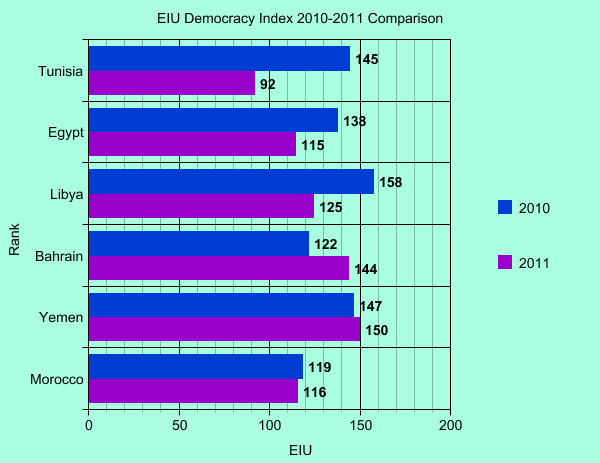
A few notes on this:
- I am not sure what their methodology is, but I suspect that once the institutional setup stabilizes Tunisia is set to pass into the second category, “flawed democracy”, rather than where it is now at “hybrid regime”. This just highlights once again what a fantastic success Tunisia has been thus far.
- I am not sure Egypt deserves a lowering of its score considering the prevalence of martial law and media control that still exists. Not to mention the whole killing protestors thing.
- It must have been very difficult to give Libya a score, considering that civil war prevailed for most of the year and chaos continues. Still, I suppose there’s no doubt it’s better than under Qadhafi.
- Big jump backwards for Bahrain.
- Interesting downgrade for Morocco. Not sure it’s entirely fair, but it may be related to other countries’ advance rather than Morocco’s fairly static situation despite the constitutional change and new government. The bottom line is that the score is still high — if the regime is even serious, we have to wait for implementation.