
Omar Mukhtar, icon of the Libyan uprising
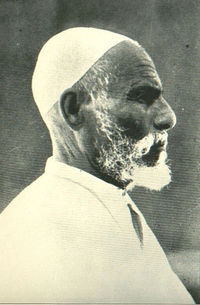 Omar Mukhtar
This is a first contribution by Arabist reader J Hammond.
On social media associated with the Libyan uprising of 2011, two images have become ubiquitous. One is the pre-Qaddafi flag of the Libyan monarchy. The other is the image of Omar Mukhtar, a guerrilla leader killed by the Italians in 1931. For Libyans, Omar Mukhtar has become what Mohamed Bouazizi symbolized for the Tunisians or Mohammed Khaled Said for Egyptians.
Such a powerful symbol is Omar Mukhtar that 79 years after his execution both the protestors and the Qadddafi regime have battled for his legacy. Qhaddafi mentioned Omar Mukhtar during his rambling hour and half speech on February 21st. Qhaddafi’s first address on September 16th, 1969 was deliberately held on the 38th anniversary of Mokhtar's death. Qhaddafi also financed a major Hollywood film about Omar Mukhtar titled “The Lion of the Desert” and starring Anthony Quinn. The film was released in 1981 and portrays Omar Mukhtar as an honorable fighter and hero. The film was banned the following year in Italy and not shown on Italian television until Omar Ghaddafi’s official state visit in 2009. A 2009 Vanity Fair article points out that Qaddafi pinned an image of Omar Mukhtar to his uniform when meeting Italian Prime Minister Berlusconi.
Italians wrested Libya from the Ottomans in the 1911-1912 Italo-Turkish War. Italian control however was nominal beyond Libya’s coast. That changed a decade later when Mussolini came to power. After brutalizing democrats and communists in Italy, he turned his attention to building an empire. To return to Italy’s control territory that had not been ruled by Rome well, since Roman times. The situation in 1922 has odd echoes to today: a dictator with delusions of imperial grandeur launches a brutal “riconquista” on the Libyan people.
The Italian’s put General Grazani in charge of “pacifying” Cyrenaica the area of Eastern Libya now the center of the anti-Ghaddafi revolt as well. Graziani described the Bedouins in the most insulting terms available to a citizen of Mussolini’s fascist Italy: Freedom loving. Graziani once wrote of the Bedouin: “Anarchist, lover of the most complete liberty and independence, intolerant of any restraint, headstrong, ignorant, unconquerable and boastful (bluffista) hero, it is sufficient that he possesses a rifle and a horse; he often masks, under the pretence of necessity of moving his tent, the desire of gaining the end of withdrawing himself from every governmental contact and control.”
Of the various Senussi resistance figures in Eastern Libya, it was Omar Mukhtar who rose to become the most prominent guerrilla leader using terrain and local support to his advantage. To which Grazani responded with a gauntlet of brutal tactics: concentration camps, a 300 kilometer wall of barbed wire, and aerial bombardment. Yet, resistance continued so Marshal Bagdolio wrote to General Grazani to extend his brutality “by now the course has been set and we must carry it out to the end, even if the entire population of Cyrenaica [Eastern Libya] must perish". Angelo De Boca, the leading Italian historian of the Colonial period called the effects of concentration camps a small genocide. In total some 40,000 Libyans perished and 20,000 were sent into exile in Egypt during the nine years of war.
As the pressure tightened, a wounded Omar Mukhtar was captured on September 11, 1931. Following his defiant refusal to retreat to Egypt. After a brief show trial, Mukhtar was sentenced to be hanged. During his three days of captivity the prize prisoner acted with dignity throughout his ordeal. The elderly Mukhtar was brought to the gallows on February 16th, 1911 and hanged before thousands of his fellow Libyans. His alleged last words were a were a reflection of his career as a Qu’ranic teacher: “Inna lillahi wa inna ilayhi raji'un” to “To God we belong and to Him we return”.
Yet Mukhtar’s Senussi religious background is not what matters most to the Libyan protestors of today. Above all it was his example as an unbending resister to heavy handed rule of authoritarianism in the face of harsh military force. As a recent Libyan protestors organizing via twitter have asked “Please pray for the people of Omar Mukhtar.”