Hulagu does Baghdad
I highly recommend you take the time this fascinating New Yorker piece on the Mongols and the sacking of Baghdad. An excerpt:
On January 29, 1258, Hulagu’s forces took up a position on the eastern outskirts of Baghdad and began a bombardment. Soon they had breached the outer wall. The caliph, who had been advised against escaping by his vizier, offered to negotiate. Hulagu, with the city practically in his hands, refused. The upshot was that the caliph and his retinue came out of the city, the remainder of his army followed, they laid down their arms, and the Mongols killed almost everybody. Hulagu told Baghdad’s Christians to stay in a church, which he put off-limits to his soldiers. Then, for a period of seven days, the Mongols sacked the city, killing (depending on the source) two hundred thousand, or eight hundred thousand, or more than a million. The Mongols’ Georgian Christian allies were said to have particularly distinguished themselves in slaughter. Plunderers threw away their swords and filled their scabbards with gold. Silver and jewels and gold piled up in great heaps around Hulagu’s tent. Fire consumed the caliph’s palace, and the smoke from its beams of aloe wood, sandalwood, and ebony filled the air with fragrance for a distance of a hundred li. (A li equalled five hundred bow lengths—a hundred li was maybe thirty miles.) So many books from Baghdad’s libraries were flung into the Tigris that a horse could walk across on them. The river ran black with scholars’ ink and red with the blood of martyrs.
The stories of what Hulagu did to the caliph vary. One says that Hulagu toyed with him a while, dining with him and discussing theology and pretending to be his guest. A famous account describes how Hulagu imprisoned the caliph in a roomful of treasure and brought him gold on a tray instead of food. The caliph protested that he could not eat gold, and Hulagu asked him why he hadn’t used his money to strengthen his army and defend against the Mongols. The caliph said, “That was the will of God.” Hulagu replied, “What will happen to you is the will of God, also,” leaving him among the treasure to starve.
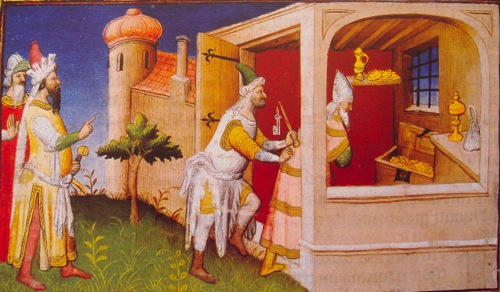
Hulagu takes the Caliph


Issandr El Amrani
Reader Comments (2)
"There and in the mountains of Persia they stopped to conquer the Assassins, an extreme Shiite sect that terrorized neighboring rulers by sending young men on suicide missions to kill them. The young men were drugged with hashish (source of the word “assassin”) and were told that when they died they would immediately go to Paradise, where women and other pleasures awaited. In no-quarter sieges, Hulagu battered the Assassins out of their mountain fortresses with his heavy weapons, and then destroyed them root and branch. Later historians agreed that in this, at least, he did the world a favor"
This is sloppy in several ways and recycles old myths that found their way (rather conveniently) into much of contemporary discourse. Books by Farhad Daftary and Nadia Eboo Jamal (amazon links below) demonstrate the spurious and concocted nature of much of the Assassin Legends (though Daftary does admit, at least in another book of his, that the missions were suicidal) and that they were not destroyed 'root and branch' - otherwise how would the Ismaili Imamate have moved on to Persia and still be in existence today!
Though it is easy to repeat such ideas, as they seem to be so prevalent, this lack of research tarnishes the piece. Other comments, such as comparing the caliphate to the papacy and calling it a spiritual leadership role only compound this.
I wonder what about the article appealed to you, or whether you agree/disagree with what I've said?
Thanks
Daftary - http://www.amazon.com/Assassin-Legends-Myths-Ismailis/dp/1850439508/ref=sr_1_1?ie=UTF8&s=books&qid=1282083315&sr=8-1
Jamal - http://www.amazon.com/Surviving-Mongols-Continuity-Tradition-Heritage/dp/1860644325/ref=sr_1_1?s=books&ie=UTF8&qid=1282083750&sr=1-1
I was appreciating the article not as a piece of scholarship — I'm no position to judge medieval history — but a piece of essay writing, for which I'm willing overlook some things like the caliphate/papacy analogy. It was a fascinating story I was not very familiar with, and it was elegantly told. Making this history accessibly to the general public in this condensed and popularized away will only encourage people to read up on the more serious scholarship — and even if they don't they'll have learned a lot of interesting things along with the few mistakes or misjudgments. You need popularizers as well as academics!
Thanks for the links to these books, too!