
Youssef Chahine...why?
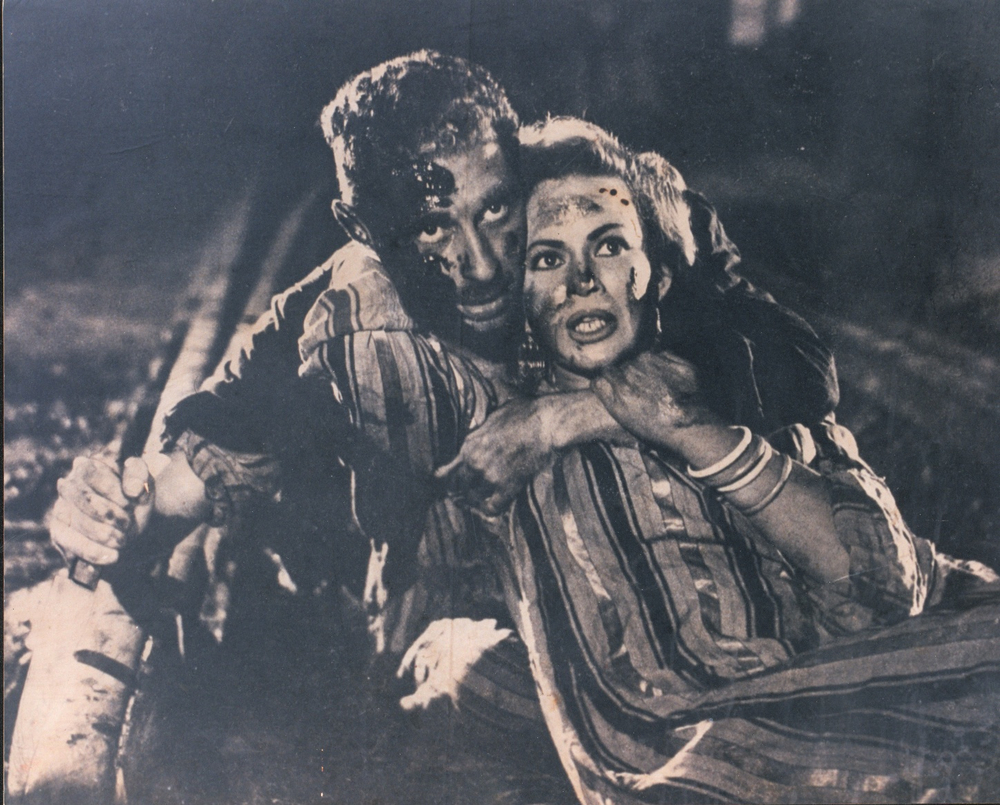 That famous scene from Bab El-Hadeed (Cairo Station). Courtesy Misr International Films
Youssef Chahine was one of the best-known filmmakers in the Middle East and – even more so – outside of it. A Silver Bear in Berlin; a life achievement award at Cannes; the bans on several of his movies, and the furious arguments over several others have all made sure of that. But was he also one of the best? Why did he alone, out of his many talented (some would say more talented) contemporaries, achieve such stature? Almost two years after the director’s death in 2008, at 82, the evaluation of his work, its significance and its influence, continues.
That's the beginning of a piece I just wrote for The Review at The National, the result of reading several books and spending all of last week watching Chahine movies--an interesting if at times tiring experience. My conclusion is that there are only three Chahine films I really like; that he had great abilities, a great eye, but his work was often undermined by his heavy-handed social and political commentary (and later, his equally heavy-handed stylistic flourishes):
Particularly in his treatment of political Islam, Chahine was always polemical and caricatural, his Islamists a bunch of schemers stroking their fake beards. Chahine’s uncompromising political stances are partly what made his name, but they also overshadowed his talents – and shortcomings – as a filmmaker. Today, the legibility of his films dates and mars them. And the critical enthusiasm in the West for films that present such simple analyses, and voice such unproblematic platitudes, seems almost condescending: “Look! An Arab humanist!”
Unfortunately a new book out by AUC does not contribute much to the evaluation of Chahine's work. The Arab National Project in Youssef Chahine’s Cinema is a useful reference. It offers synopses, summaries of critical reactions (mostly from the Arab world) and many grand claims for Chahine’s films. They “converge the popular with the ideologically counter-hegemonic or subversive;” “deconstruct the representations and discourses that have limited the self-representation of Egyptian and Arab people;” and “function as agencies of modernist cultural practice through an exploration of their postcolonial narrative delineations of social inequalities, colonialism, capitalist globalization, ethnic and religious heterogeneity, non-normative sexuality, the Palestine question, [the list goes on].” What author Malek Khouri doesn’t do is explain persuasively or clearly (a difficult task, when encumbered with so much jargon) how all this is accomplished. I believe he overrates the originality, subtlety and relevance of Chahine's socio-political interventions. And he barely evaluates Chahine's films qua films at all. In fact he doesn't give any sense of the experience--for good or bad--of watching Chahine.