
Iran, the US, and democracy promotion
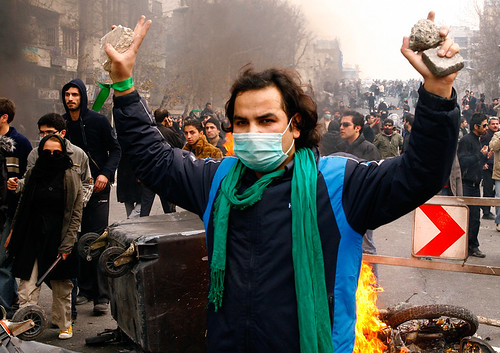 A protestor in Tehran, from Flickr user Green Movement
POMED's account of a recent Congressional hearing on what policy to pursue towards Iran, and most notably whether and how to support its opposition movement, made for some interesting reading. Several of those testifying — former Bush administration officials, regional experts, etc. — made the case of a human rights-based approach, with the US taking steps to challenge the legitimacy of the Islamic Republic's regime on human rights grounds. The approach being suggested by, if you compile the different witnesses' testimonies to the House Foreign Affairs Committee, is basically:
- Highly targeted sanctions to hurt the elite, esp. the IRGC;
- Open support for the Green Movement, which can decide whether it accepts that support or not;
- More funding for democracy promotion through the National Endowment for Democracy and other vehicles (although it's not clear who would eventually receive that money);
- A commitment to continue to side with the opposition no matter what takes place in the negotiations over the nuclear program, so that no "betrayal" of the Green Movement takes places if the regime is willing to back down;
- A public diplomacy campaign and commitment to internal regime change as an ultimate goal, which would also solve the nuclear issue.
I should add that Genevieve Abdo in particular was less gung-ho, and suggested that a reconciliation between the regime and opposition leaders could very well take place by the next parliamentary elections, which would leave the more radical elements of the Green Movement out on their own. I don't know much about Iran but I also see no reason a more democratic government in Iran would not be attached to a nuclear program considering the threats the country faces in the region. Logically, all of the larger Middle Eastern powers should pursue WMD programs of some sort, and indeed they all have (mostly chemical and biological for Egypt, Syria and Iraq and of course Israel's nuclear arsenal).
All of this to say: we are seeing considerable Congressional enthusiasm for a tough, democracy-driven (at least on the surface) policy towards Iran. Yet, at the same time, democracy is effectively absent from the relations between the US and Arab states (no, I will not count the State Dept. annual rights report). It is true that Iran's opposition is potentially much more credible than opposition movements in Arab countries, with seemingly real elite and popular traction. But that's also because in many respects are less democratic, and have less healthy political systems, than Iran's theocracy.
I am very supportive of the Green Movement, whatever it may actually be, and the goal putting an end to the militarization of the Islamic Republic, its corruption and its human rights abuses. I hope it's possible, and am conscious the US can influence this. But when I see US policy elsewhere in the region, I would warn Iranians: don't take this democracy talk too seriously. To paraphrase Ronald Reagan (invoked in the Congressional hearing for an uncompromising stand on Iran): don't trust, and verify.
Incidentally, Juan Cole outlines some of the scaremongering by SecState Clinton about Iran's nuclear program.